



He studied in London at the Saint Martin’s School of Art (1920-1921) and the Royal College of Art (1921-1923). Upon graduation, he split the First Prize for Drawing with his fellow student Henry Moore. He taught art at the Pancyprian Gymnasium (1926-1962) in Nicosia. He spearheaded the creation of the Cyprus Folk Art Museum and was its first director (1950-1994).
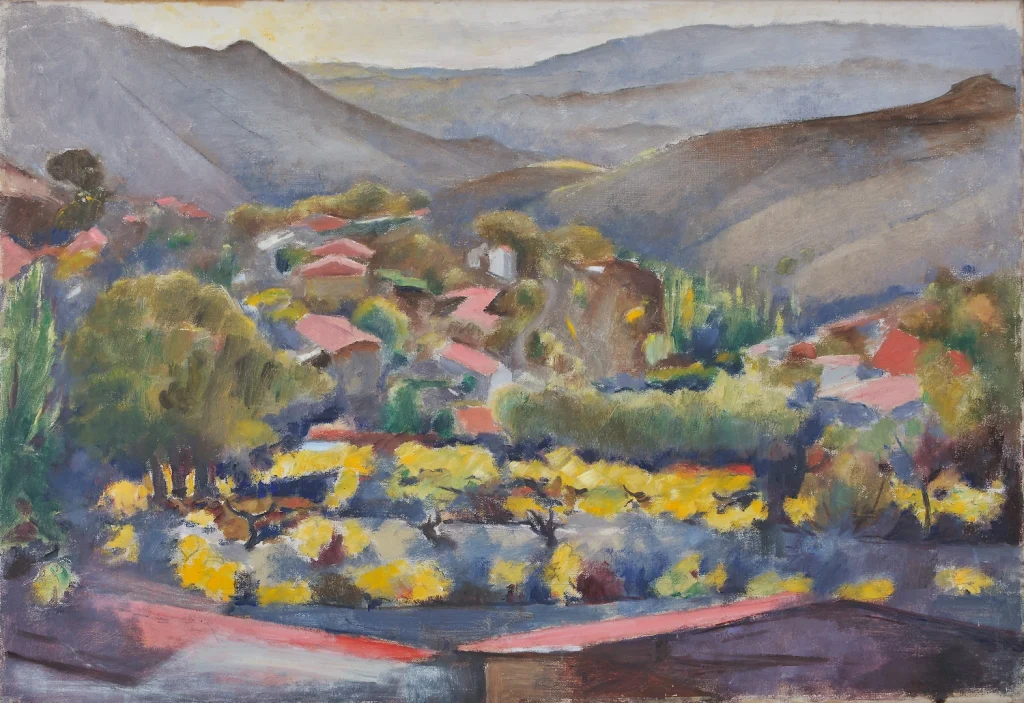
He developed his own style through the study and unrestricted use of different artistic idioms. He especially studied classical values and delved into the work of El Greco, Cézanne and other Modernist artists. At the same time, he kept alive the artistic tradition of his homeland, by inseminating his works with the forms of ancient and Byzantine art. He drew his subjects from the landscape and the human element of Cyprus, which he did not try to describe but to interpret. His painting focuses on the formal, the universal and the monumental. Between 1967 and 1972 he painted the monumental work The World of Cyprus (1.75 x 17.5 m) and from 1963 to 1977 a series of eight works under the general title Agonies.
He showed his work in solo exhibitions in Nicosia (1957, 1975, 1977, 1989), Athens (1962, 1989) and London (1964, 1979), as well as in group exhibitions in Cyprus and abroad. Retrospective exhibitions of his works were organised by the National Gallery of Greece in 1976 and the Ministry of Education and Culture of Cyprus in 1994. He received the Award of the Academy of Athens (1976) and the Excellence Award in Letters, Arts and Sciences of the Republic of Cyprus (1993).