



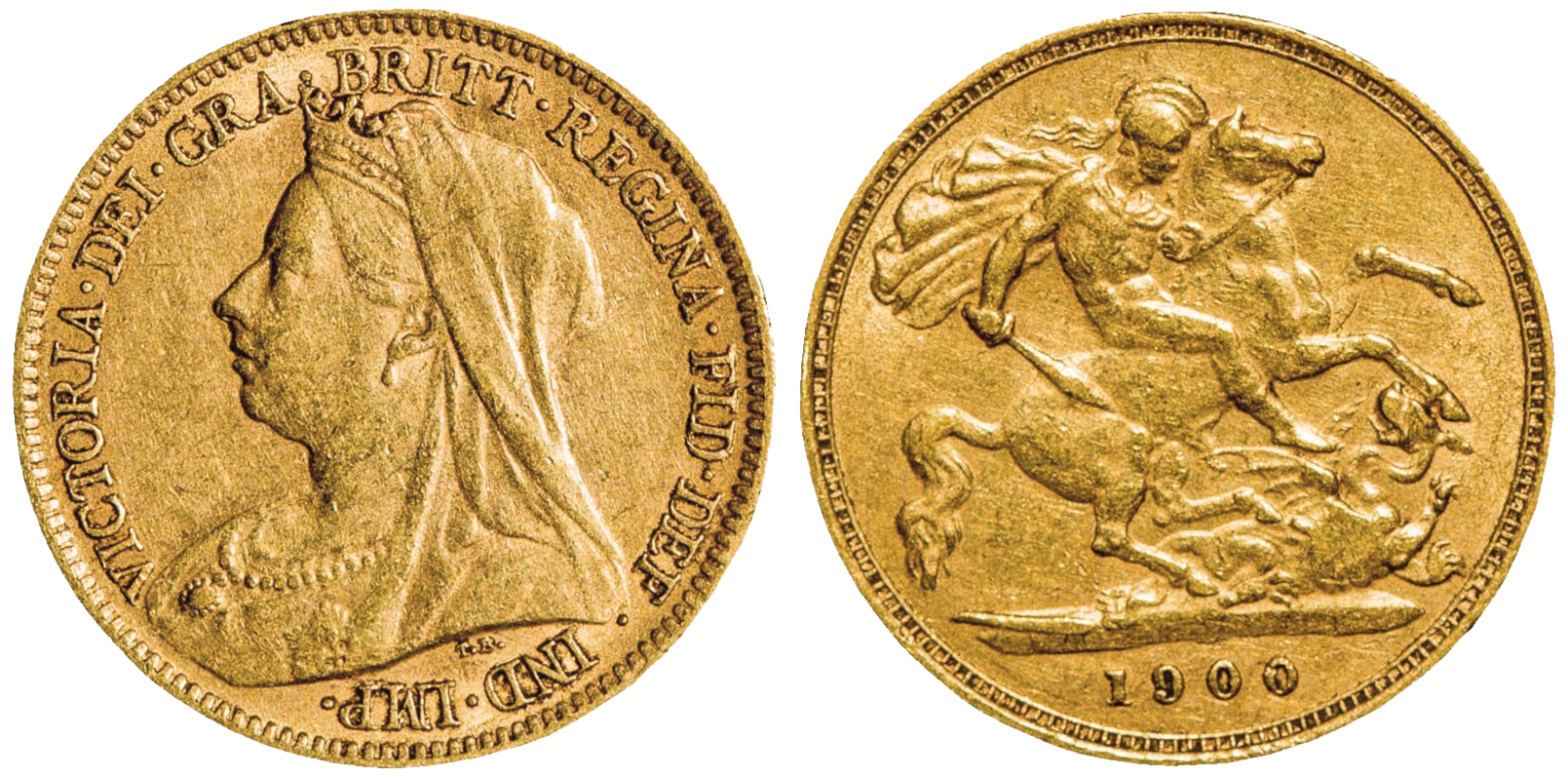
London, 1900
Half Sovereign
Victoria became queen at the age of 18 on the death of her uncle, William IV, in 1837. Her reign of almost 64 years is the second longest in British history. She was the first British monarch to see her name given to the period of her reign whilst still living. Victoria is associated with Britain’s great age of industrial and economic progress and the expansion of the British Empire. In 1858 India came under the direct administration of the British government, and in 1877 Victoria became Empress of India. London developed into a trading hub for international transactions, and by 1870 more than 60% of global trade was settled in sterling. By the end of Victoria’s reign, the British Empire extended over about one fifth of the globe, and it was said that ‘The sun never sets on the British Empire.’
The Collection includes 174 coins from the reign of Victoria. They include five- and two-pound coins, sovereigns and half sovereigns struck at the Royal Mint and sovereigns and half sovereigns issued by the colonial branch mints of Sydney, Melbourne and Perth. There is also a Jubilee gold and silver proof set, issued in London in 1887, with eleven gold and silver coins from five pounds to threepence.
During Victoria’s long reign, three different portraits for coins were designed, all facing left: these are grouped into three main sections, ‘Young Head Coinage, 1838-1887’, ‘Jubilee Bust Coinage, 1887-1893’ and ‘Old Bust Coinage, 1893-1901’. The first portrait for Victorian currency sovereigns depicts a standard young head engraved by William Wyon. The engraver’s initials, W W, appear in relief on the truncation. This young head, with small differences, remained on sovereigns for almost 50 years, from 1838 to 1887. The first reverse of these sovereigns was engraved by Jean Baptiste Merlen and features the new crowned shield design within a laurel wreath. From 1863 to 1874 the Royal Mint in London, for quality-control reasons, added a tiny die number to the reverse die of gold sovereigns. This die numbering occurred additionally on gold half sovereigns from 1863 until 1880.
In 1871 there was a revival of Pistrucci’s St George and the dragon on the reverse of the gold sovereign, which ran concurrently with the shield reverse sovereign at the Royal Mint until 1874 inclusive. After the reintroduction of St George and the dragon, the young head obverse no longer carries the date of the coin, which for the St George and the dragon reverse after Pistrucci is always in the exergue on the reverse. The initials WWP, which correspond to the Master of the Royal Mint, William Wellesley Pole, who was instrumental in commissioning Pistrucci to design the new sovereign in the first place, continue to appear in relief under the broken lance on the ground. These initials remained in this position into the reign of George V over a hundred years later. Pistrucci’s initials, B.P., also continued to be included in the upper right of the exergue and they remain on sovereigns issued today.
The second portrait was created in 1887 to celebrate Victoria’s golden jubilee. The new portrait, modelled from life and engraved by Joseph Edgar Boehm (1834-1890), was used on all gold and silver coins. His initials, J.E.B., appear below the bust. The reverse of all jubilee gold coins, together with the five-pound, two-pound and sovereign coins, has the St George and the dragon design; only the half sovereign retained a crowned garnished square-topped shield. The golden jubilee five- and two-pound denominations were struck in 1887 only. The jubilee coinage also marks the first time in British currency coinage that the die axis is upright [en médaille], a practice followed by all subsequent monarchs. The jubilee portrait lasted on British coins only from 1887 to 1892 inclusive because of serious criticism about the way the crown appeared upon the queen’s head.
The third and final portrait of Victoria was issued in 1893 and was used to great acclaim until her death in 1901. The sculptor Thomas Brock (1847-1922) designed the new older ‘widow’ bust with a heavy veil, which was engraved by the then chief engraver of the Royal Mint, George William De Saulles (1862-1903). Brock’s initials, T.B., appear below the bust. From 1893 Victoria’s titles also include Empress of India. On the reverse the design of St George and the dragon continues unchanged and was introduced also to the half sovereign, thus achieving uniformity in Britain’s gold coinage for the next 100 years.
During the second half of the 19th century, Britain became the world’s leading industrial and financial centre. With the expansion of the British Empire, with colonies established all over the world, there was a greater need for currency and especially for gold sovereigns. To face this problem, the Royal Mint began to operate branch mints overseas. To distinguish the different colonial mints, small mint marks were introduced on the surface of the coins. The London mint has no mint marks.
The first colonial mint to operate was in Sydney, Australia, from 1854, only a few years after the discovery of gold in New South Wales in 1851. The Sydney Mint imperial type Victoria sovereigns bear the mint mark S. The second mint to open was in Melbourne (mint mark M) in 1871 and the third in Perth (mint mark P) in 1899. Initially the Sydney mint mark S appeared on the obverse below the young head of Victoria’s sovereigns from 1871 to 1887; and the Melbourne mint mark M in the same place from 1872 to 1885. From 1887 onwards, all mint marks were inserted on the reverse in the centre of the ground of the St George and the dragon design. During the reigns of Edward VII and George V, further colonial mints were opened in Ottawa, Bombay [now Mumbai] and Pretoria.
Obv.: Old crowned and veiled bust of Victoria, facing left, wearing a pearl necklace and pearl drop earrings; she wears a thick veil, which covers most of the Star of the Order of the Garter on her breast; below the curved truncation of the bust the initials T.B. correspond to the name of the sculptor Thomas Brock; surrounded by an abbreviated Latin legend.
Legend: VICTORIA DEI·GRA·BRITT·REGINA·FID·DEF·IND·IMP·, which reads ‘Victoria Dei Gratia Britanniarum Regina Fidei Defensatrix [or Fidei Defensor] India Imperatrix’, meaning ‘Victoria, by the grace of God, Queen of the Britains, Defender of the Faith, Empress of India’.
Rev.: St George on horseback advancing to the right, slaying the fallen dragon with a sword; he wears a helmet with flowing streamer and a cape; the horse with a long tail; on the ground on the left a broken lance; under the lance the initials WWP in relief correspond to the name of the Master of the Royal Mint, William Wellesley Pole; in the exergue the date 1900.
Edge: Milled.