



Mexico City, 1947
Commemorative coin, 50 Pesos
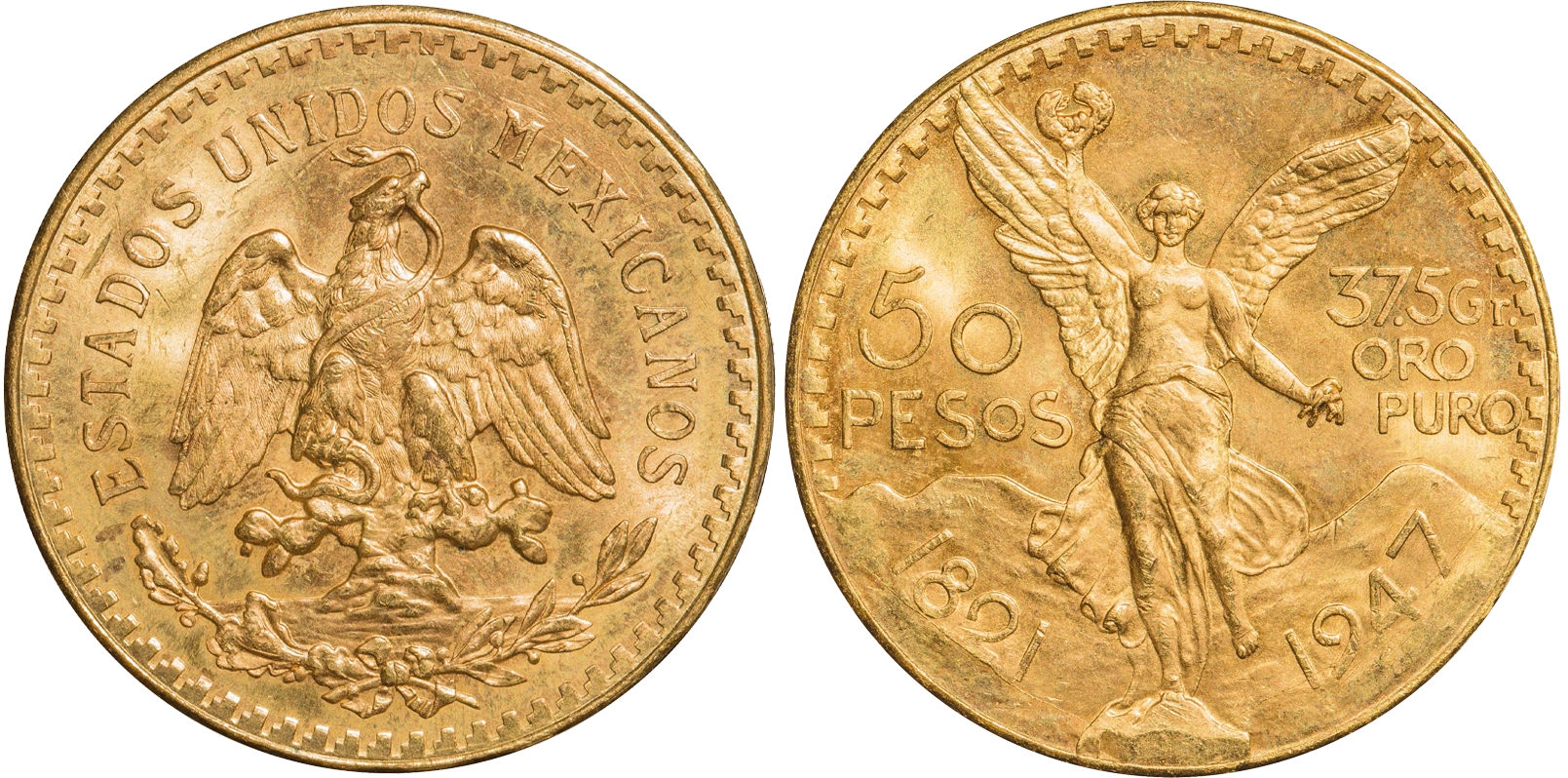
The Collection includes one Mexican commemorative coin, known as a ‘centenario’. It was minted to commemorate the centennial of Mexican independence from Spain in 1821. First issued in 1921, it was discontinued in 1931 and began to be made again in 1943, due to the increased demand for gold coins prevailing at that time.1 Between 1949 and 1972 nearly 4 million pieces were issued, which were almost certainly all dated 1947; among these is the specimen in the Collection.
The obverse presents the Mexican national emblem surrounded by the legend Estados Unidos Mexicanos; this legend was introduced on coins with the monetary reform of 1905 that also adopted the gold standard. The emblem refers to an old Aztec legend, according to which the sun god Huitzilopochtli told the Aztecs to settle at the place where they would see an eagle holding a snake; they did so and founded the city of Tenochtitlan there, today’s Mexico City. The figure of Liberty, or the ‘The Angel of Independence’, on the reverse is placed in front of two famous volcanoes that overlook Mexico City, the Popocatépetl and the Iztaccíhuatl. Their names refer to an Aztec legend, according to which Popocatépetl [Smoky mountain] was a brave warrior and the lover of the ruler’s daughter, Iztaccíhuatl [White lady].
The coin has a nominal denomination of 50 pesos. The word pesos meant a weight that was used to weigh gold and copper; these alloys were used by the Spanish conquerors in the 16th century to produce metallic discs aiming to imitate European coins. From these originated the future Latin American currency unit, the peso. The first 1 peso coins, as well as the minting of currency under the decimal system, were introduced in Mexico by Maximilian I (1864-1867).
The Aztec Empire was famous for its gold, used for religious artefacts, as well as for decorative elements. In 1519, in search of gold, Hernán Cortés (1484-1547) conquered the Aztec Empire in the name of Charles I (1516-1556) of Spain. For almost 300 years Mexico was the Viceroyalty of New Spain (1535-1821) and eventually the source of great wealth for Spain with the supply of fine metals. The discovery of the region’s mineral wealth resulted in the growth of trade and subsequently led to the need to produce money. In 1535 the mint of Mexico (la Casa de Moneda), the first in America, was founded following a mandate from the king of Spain.
Obv.: Coat of arms presenting the Mexican eagle with its wings displayed in a battle attitude: it is perched on a blooming nopal (prickly pear) cactus that is growing from a rock that emerges from a lake; it is holding a snake with its right talon and beak; below two branches, one of oak and one of laurel, form a lower semicircle united by a ribbon; above a Spanish legend; all within a patterned circle.
Legend: ESTADOS UNIDOS MEXICANOS, meaning ‘United Mexican States’.
Rev.: Winged Victory is striding forward in front of two volcanoes, holding a laurel wreath in her raised right hand and broken chains in her left; to the left the denomination 50 PESOS; to the right the gold content 37.5 Gr. ORO PURO; below the dates 1821 and 1947; Spanish legends; all within a patterned circle.
Legend: 50 PESOS / 37.5 Gr. ORO PURO / 1821-1947, meaning ‘50 pesos / 37.5 g pure gold / 1821-1947’.
Edge: In incused lettering: INDEPENDENCIA Y LIBERDAD, meaning ‘Independence and Liberty’.