



Constantinople, 475-476
Solidus
In 475 Basiliscus usurped the throne from the Emperor Zeno (474-475, 476-491). His reign was unpopular and lasted only a year. In 476 he was exiled by Zeno to Cappadocia, where he starved to death.
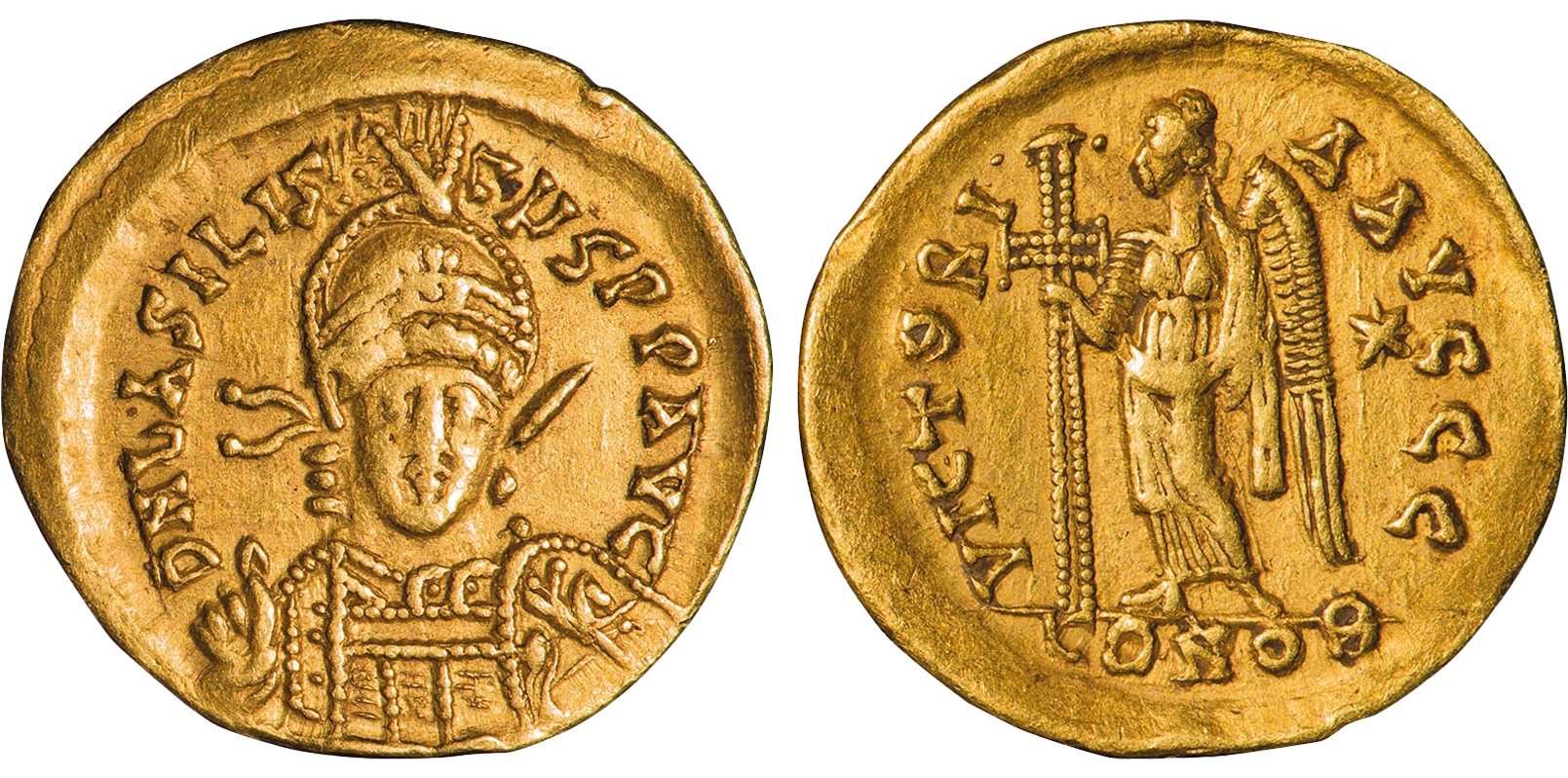
The coins issued by Basiliscus and Anastasius I represent the early phase of Byzantine coinage. The 5th-century coins continued to present the distinctive features of Late Roman coinage. The emperor is depicted in military attire, displaying the ‘majesty of the imperial office’; he is wearing a cuirass and a helmet and is armed with a spear and a shield. The reverse presents the figure of Victory, a traditional Roman coin type; she is now holding a long cross instead of a wreath. Moreover, the Latin inscriptions, which read as ‘Perpetuus Augustus’ and ‘Victoria Augustorum’, refer to Roman imperial titles.
Obv.: Bust of the emperor three-quarters right, wearing a helmet with plume, trefoil ornament and diadem, the ties of which show to the left, and a tunic and cuirass; in his right hand he holds a spear behind his head; on his left shoulder, a shield with the device of a horseman; surrounded by a Latin legend.Legend: D N bASILIS / CuS PP AVC, which reads ‘Dominus Noster Basiliscus Perpetuus Augustus’, meaning ‘Our lord Basiliscus, perpetual Augustus’.
Rev.: Winged Victory standing to the left, holding a long jewelled cross with her right hand; to the right, a star; in the exergue CONOB; surrounded by a Latin legend.
Legend: VICTORI / A AVCCC, which reads ‘Victoria Augustorum’, meaning ‘Victory of Augustus [of the emperor]’. The letters CONOB in the exergue stand for the mint of Constantinople [CON] and for obryzum [OB], meaning fine gold. OB corresponds to the abbreviated Greek number 72, that is, 1/72 of a Roman libra (about 324 g).