



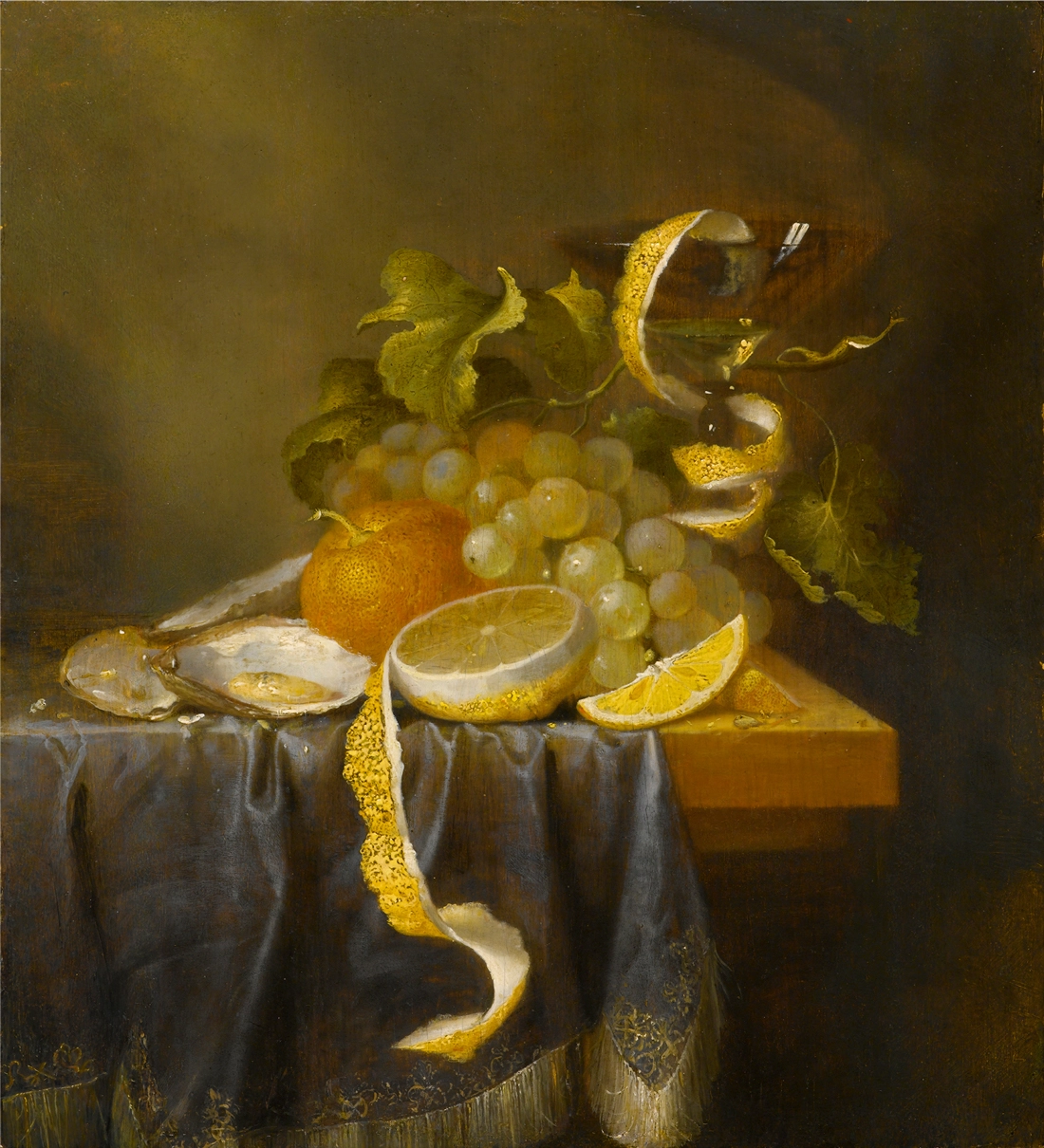
Exotic, imported goods pile up on this splendid, cloth-embellished table, painted by Laurens Craen. There are oysters, citrus, grapes – even a costly Façon-de-Venise wine glass with a lemon peel curling decoratively around its stem. The latter is a nod, perhaps, to period tastes: a few drops of lemon were added not just to oysters, but also to white wine, to enhance its taste.
Not much is known about this Dutch painter, who vividly captures sheens and textures on his wooden table, other than that he briefly worked with Jan Davidsz de Heem – the celebrated, deeply influential master of the still life genre. Yet, the just over two-dozen paintings ascribed by scholarship to Craen’s talented hand underline the artist’s signature style: his preference for soft, oblique lighting; and his love of swirling vine foliage and calligraphic lemon peels, curling against stemmed Venetian-style glasses. Characteristic too, is this blue cloth with its rich, tasselled, embroidered fringe: appearing in several of Craen’s paintings, it seems to have been a studio prop, used by the artist to evoke a sense of luxury.
A sense of opulence, in fact, is key to reading this image, painted in the time when the port-cities of the Netherlands overflowed with the bounty of global commerce. An emerging class of Dutch merchants actively sought out such images of affluence, of exotic goods and the earthly pleasures. But alongside luxury was also room for moralisation – of warning against the vices of indulgence: if the oyster speaks of carnal desire, its empty shell is a symbol of mortality, and the bitterness of the lemon a reminder of the remorse that often follows laxity and excess.
EXHIBITION: Athens 2012.
LITERATURE: NG 2012, pp. 27-28, 208, illus.: p. 28.