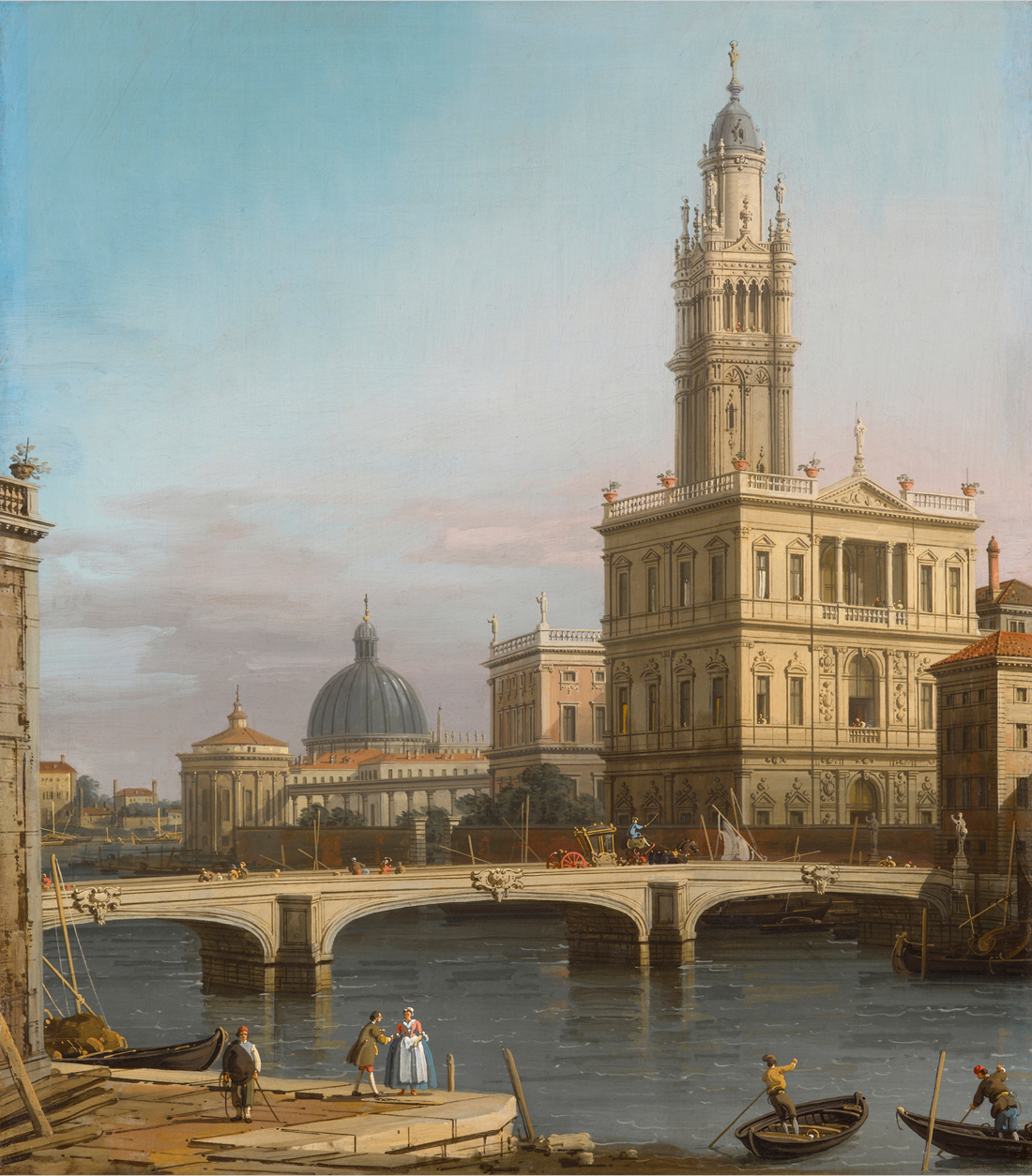
The Capriccio has proved rather more controversial. While Rosenberg saw it as an assemblage of buildings inspired by London, several of the architectural features are demonstrably of Italian origin, and Links felt that, ‘The presence of the Ponte S. Trinità [over the Arno in Florence] inevitably casts doubt on the attribution. Canaletto was never in Florence, as far as is recorded, and certainly painted no other Florentine building.’ He concluded that the attribution of the Capriccio ‘is far from secure’ and catalogued it as ‘Attributed to Canaletto’. While the attribution to Canaletto is incontestable, the painter’s awareness of the view of the Ponte Santa Trinità from the terrace of the Palazzo Corsini remains unexplained. The most obvious graphic source, Giuseppe Zocchi’s print, plate VI of his Scelta di XXIV vedute delle principali contrade, piazze, chiese, e palazzi della città di Firenze published in 1744, shows the bridge rather differently and from the opposite side of the river. Corboz has pointed out that the central part of the palace on the right strongly resembles the centre part of the garden front of the Villa Aldobrandini at Frascati, as shown in Dominique Barrière’s engraving of 1647. He also noted that the top of the campanile is very similar to that in a capriccio drawing by Canaletto in the British Museum.